Overview
YanezYID lets a partner verify that a user has a Yanez biometric identity.
YanezYID is a Proof-of-Humanity / Proof-of-Uniqueness system. Biometric features are turned into cryptographic keys on the user's device, on the fly — the biometric never leaves the device and is never stored. Because the keys can only be produced by the live person, a valid signature is proof of presence (liveness), not merely possession of a stored secret.
A partner integration uses YanezYID to:
- Link a Yanez identity (
yid) to a local account. - Guarantee one human → one account (anti-sybil) via Yanez's deduplicated registry.
- Gate sensitive actions on a fresh biometric signature (step-up / 2FA).
The partner does not capture biometrics, derive keys, or establish uniqueness. Those live in the Yanez app (on-device) and the Yanez registry.
The main identifiers are:
partner_id: the Yanez-issued identifier for the partner.kid: the partner signing-key identifier.yid: the Yanez biometric identity identifier for a user.public_key: a user public key associated with a Yanez identity record.
Architecture
| Role | Responsibility |
|---|---|
| Partner app (client) | UI only. Requests challenges, renders the QR / opens the deep link, waits for the result. Performs no verification. |
| Partner backend | The security boundary. Issues challenges, receives callbacks, verifies signatures, checks the registry, stores account↔yid links. |
| Partner DB / cache | Persists account↔yid links (durable) and open challenges (short-lived). |
| Yanez app | Holds the user's bio-derived keys; signs challenges on-device. |
| Yanez registry | Source of truth for uniqueness and the yid ↔ keys mapping. |
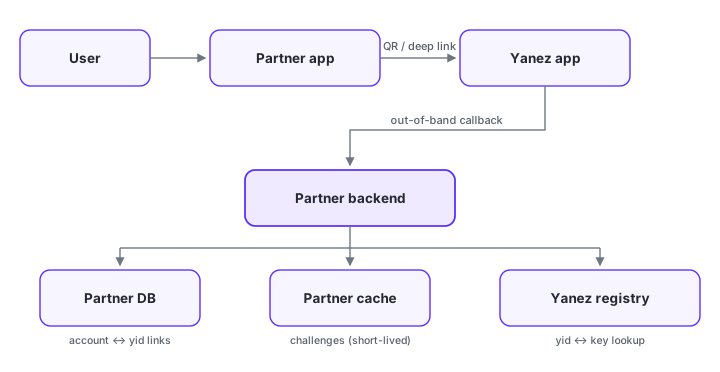
The partner backend is the only place a signature is verified — see Deep link signing and Callback verification for the request/response detail behind this diagram.
Partner request signing
Separately from the verification flow above, the partner backend authenticates its own calls to Yanez APIs (e.g. the record validation API) with Ed25519 request signatures:
Partner app or website
  -> calls partner backend

Partner backend
  -> stores partner private key
  -> signs Yanez API requests
  -> stores partner-side user/session state

Yanez block_search service
  -> stores partner public keys
  -> verifies signed partner requests
  -> validates Yanez identity records
The browser or mobile app should not hold the partner private key. If a user flow needs a signed Yanez request, the partner app asks the partner backend to create it.
What Yanez Provides
During onboarding, Yanez provides:
- a
partner_id - registration of the partner public signing key
- sandbox and production base URLs
- supported platform flow details
- support contacts for launch readiness
Yanez does not store partner private keys.
Integration Surfaces
| Surface | Purpose |
|---|---|
| Partner request signing | Authenticate partner backend requests to Yanez. |
| Record validation API | Validate a yid and optional public-key binding. |
| Platform handoff | Start or return from web, Android, or iPhone user flows. |